
Contra Hard Corps story
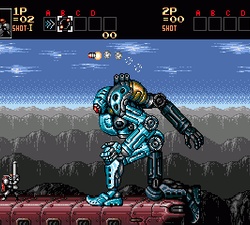
For a lot of us, Contra on the Sega smells like a cartridge with a black label and that blazing Konami logo. In some places it showed up as Probotector—with steel-clad heroes instead of humans; elsewhere the sticker flexed a no-nonsense Contra: The Hard Corps. Among friends, though, it was simpler: "We’re clearing Hard Corps tonight," and the controllers were already trembling with hype. This thing crashed into the 90s like a rock-and-roll shockwave: a blistering run-and-gun side-scroller, screen-filling bosses, and that hit of adrenaline, FM synth, and sparks spraying from under a full-tilt sprinting hero.
How it all started
Konami built up to it, step by step: after the 8-bit Contra successes, they wanted a version that looked and sounded like a blockbuster. The Sega Mega Drive—aka Genesis—was a perfect fit: beefy audio for its day, snappy scrolling, that "arcade at home" feel. The team decided a straight retread wouldn’t cut it. Enter the "squad"—distinct characters with their own quirks—and alongside that, a plan to branch the campaign. It’s still a ferocious run-and-gun, but now with route selection, multiple endings, and the sense that you’re not just holding fire—you’re living a brazen combat story.
Release window: mid-90s, when the genre knew how to pull emotions and devs knew how to wring every byte out of a cart. Hard Corps became Contra’s coming-of-age statement: relentless pace, action-movie staging, whip-quick scene changes—from street firefights to deranged mechanical beasts morphing before your eyes. All of it riding a metallic, angular chiptune score where FM synthesis growls like a sports car and the percussion chatters like a belt-fed.
Different versions — one legend
The naming saga is its own song. In the States the box read Contra: Hard Corps, in Japan the same fighting spirit but with a "The" up front, and in Europe the prim Probotector: heroes "armored up" as robots to meet local rules. On our markets everything turned up at once—someone lugging a PAL Probotector, someone a hard-as-nails US cart, and even the Japanese build with a softer balance. So the nicknames stuck: today it’s "Hard Corps," tomorrow just "Contra on the Sega," and everyone gets what you mean. That game where two-player co-op, shoulder to shoulder, chews through a mechanical apocalypse—and you argue at school over which branch leads to the "proper" ending.
That mix-up with titles and covers actually helped: the game felt like it toured the world, donning a new mask in every region. Video clubs parked it alongside the hottest Mega Drive staples, and bootleg cartridges—where "Hard Corps" got mashed into "Hardcorps" or morphed into "Contra Hard Corps"—did their job: interest only grew. Plenty of kids learned the word "hardcore" right here, taking the title as a promise of fair, no-compromise challenge.
How it spread and why we loved it
Hard Corps ripped across the globe fast: in America it hit as a straight, arcade-grade jolt to the nerves; in Japan, for its style and rhythm; in Europe, for that signature Probotector drive. For us, it was the dare. The bring-it-over cart you were proud to show: two-player co-op, a jump-into-dash combo on your fingertips, and endless talk about who managed a no-miss clear. And the respect for audacity: few teams squeezed this much direction into a cartridge. Strobe flashes over a nighttime megacity skyline, rooftop dashes under clanking treads, a train barreling into the dark—together they set the stage for a big adventure in 16-bit scenery.
The branching paths took center stage. For a run-and-gun, it was fresh air: one choice and you’re in a new set piece, new bosses, a different finale. Multiple endings worked like a magnet: tapes passed hand to hand, Mega Drive diehards argued at stalls and in stairwells about which route was "canon." And that soundtrack—thick and crunchy—became its own talking point: equal parts industrial drive and shameless guitar swagger, exactly what the Mega Drive’s FM chip could spit out when handled with love.
A legacy you can feel in the controller
Over time, Hard Corps became a shibboleth for the "in-crowd" taste. Say "Contra Hard Corps" and everyone nods: it’s an honest side-scroller where every pixel hinges on controller response. It’s Konami at full stride delivering not just another follow-up but a bold offshoot—with its own face, a wink of irony, and whip-smart direction. A game that paired "legendary difficulty" with sheer momentum and keeps pulling you back years later to sync with that rhythm again—run-and-gun with no brakes, where the route you pick rewrites your whole evening.
And yeah, argue all you like about the name—Probotector, Contra: The Hard Corps, or simply "Contra on the Sega"—the love is the same. A rare case where different versions and localization only amplified the myth. Branching stages, bosses that swallow half the screen, co-op, and chiptunes that beg you to crank the volume—together they form a story you can’t help retelling. Not a museum whisper, but the living heartbeat of those 90s nights when you dropped another metal monstrosity and laughed out loud: we did it!